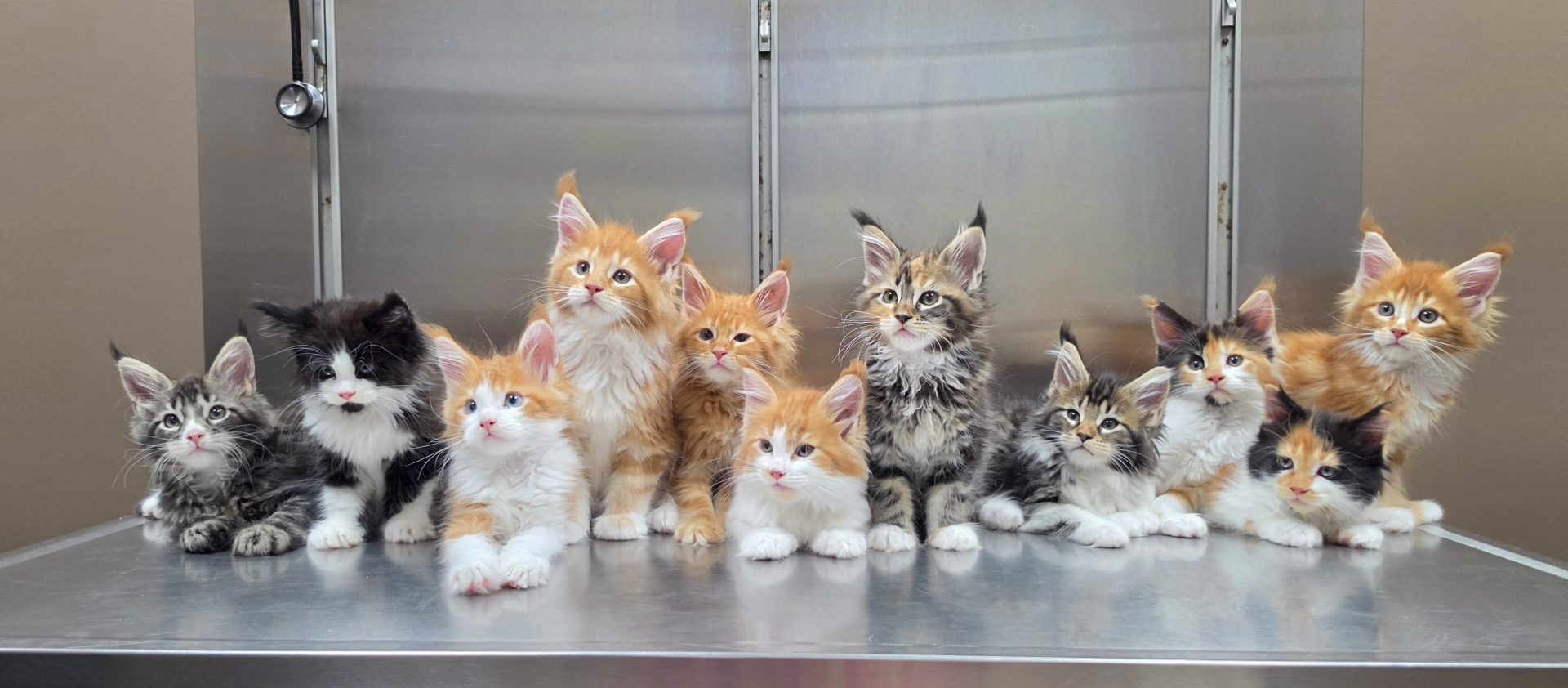

Frequently Asked QuestionsAbout Our Coon Cats
The Maine Coon Cat is a large and very social family cat, having a well deserved nickname of “the gentle giant”. Often described as dog-like, the Maine Coon will follow their family members from room to room in the home always needing to be in view of the action. They also adapt easily to walking on a harness and leash. Some Maine Coons are even known to have a natural liking of water. Playful, confident, and intelligent by nature, the Maine Coon provides constant entertainment for themselves and their family members. Uniquely, a Maine Coon is animated and engaging with their family by vocalizing with various trills and chirps, rarely meowing. Maine Coons get along with other cats, children, and dogs if introduced appropriately at a young age. And Maine Coons love to travel with their owners by car or by air once they get a taste of it.
The Maine Coon is the largest non-hybrid breed of domestic cat. A Maine Coon Cat that was the former Guiness World record holder of being the longest domestic cat measured 4 feet in length! Our intact fully grown breeding males generally range from 22 to 28 lbs, with Midas sometimes topping 30lbs depending whether his mind has been on food or women lately. A Maine Coon is slow to mature and does not normally reach full size until 3-5 years old. Sterilized male and female Maine Coons will often weigh more than intact Maine Coons. It is impossible to predict how big a kitten will grow to be at maturity as genetics, nutrition, and proper care all play roles in the development of a cat. Our female breeding Maine Coons generally range from 11 to 15 lbs when not pregnant.
In the best interest of the health of our breeding cats and their kittens we do not allow the public into our home just to see and touch our European Maine Coon Cats and Kittens. Kittens do not have fully developed immune systems and allowing the public in would put them at potential risk for outside diseases prior to having all of their immunizations.
Maine Coon kittens grow more slowly but for longer than other cats, so they are a little bit slower to develop independence from their mothers than other cats. They ready to join their new homes at 12 weeks of age.
Maine Coons get bored of the same food every day, and when that happens they stop eating well and don’t reach their full potential. Maine Coon kittens need a variety of textures and ingredients, and this is best achieved by rotating among high quality brands. We recommend that dry kitten food be available to the kitten at all times, and that wet kitten food should be fed twice a day. Maine Coon kittens should stay on kitten food for a full 18 months before switching to adult cat food. We rotate between Orijen, Acana, Royal Canin and Instinct dry kitten food, and Orijen, Acana, Royal Canin and Weruva wet kitten food. This also means that your kitten is already used to a variety of foods by the time you get your first cuddle.
For the entire time they are with us, our kittens have access to the Tidy Cat Breeze XL litter box system their mother uses. That is an excellent choice that we recommend for you too if you do not already have a litter and litter box type you love. But we don’t stop there. At around 4 weeks of age, we introduce an additional traditional litter box with nonclumping clay litter. At 6.5 weeks we change the litter for the traditional box to Dr. Elsey’s Kitten Attract clumping cat litter. Finally, at 9 weeks, we change the litter in the traditional litter box to Clump & Seal Multicat or Clump & Seal Microguard, which is what we recommend in the new home for those who prefer traditional clumping litter. So by the time you get your Maine Coon kitten, your furry one will be used to both a traditional litter box with clumping litter and the Tidy Cat Breeze XL litter and litter box system, and you can use either or both without any additional learning curve. Just remember to get extra large litter boxes — Maine Coons won’t fit in a standard size for very long.
No. Our blue-eyed kittens are not deaf, and they do not have any of the genetic defects that are sometimes associated with blue eyes in other cats. In fact, our blue-eyed breeders have tested negative for 49 different genetic issues. The dominant blue eye genes in Jellico Dream’s blue-eyed breeders are very special, and they produce perfectly healthy blue-eyed kittens. I back this with a full 1 year written guarantee against genetic defects. This guarantee applies regardless of eye color.